// DATA-DRIVEN DIGITAL EXPORT

Building Foreign Trade Independent Websites & Google SEO
First, transform your website into a business tool capable of receiving inquiries.

If your biggest concerns right now are: an unprofessional-looking website, ads that generate traffic but fail to convert into inquiries, or uncertainty about where to begin with SEO—this page is for you. What we deliver isn’t just a ‘good-looking website’ or ‘impressive-sounding SEO’; rather, we first help you build a solid foundation—an independent website that overseas customers understand, trust, and feel motivated to contact—and one that supports ongoing Google SEO growth.

50+
Covers Traditional Foreign Trade Industries
GSC
Rolling Retrospective Based on 28 Days of Real Data
< 3s
Global Page Load Latency for Independent Websites
0
Using Black-Hat Violative Techniques
// Our Technical Philosophy

What foreign trade independent websites truly need to solve
is not just going live, but whether they can consistently receive the right inquiries.

⚡
First, transform your website into an inquiry-ready page that customers can instantly understand.
Many foreign trade websites’ problems aren’t ‘not being launched’—rather, their homepages fail to clearly state what they sell, product pages lack credibility, and contact pathways are too weak. We first address page structure, loading speed, language versions, mobile experience, and inquiry entry points—ensuring the site possesses baseline capability to receive customers.
Understand System Architecture →
🎯
SEO isn’t about churning out articles—it’s about gradually strengthening pages that convert.
For B2B independent websites, the most valuable SEO work isn’t publishing dozens of extra articles; it’s correctly optimizing product pages, service pages, case study pages, and high-intent question pages—then continuously leveraging Search Console to identify which keywords merit pursuit and which pages need further enhancement.
Access Long-Term Optimization Dashboard →
🤖
AI Search Isn’t a Novelty—It’s Whether Your Website Will Remain Visible
If your customers have already begun comparing suppliers within Google AI Overviews, ChatGPT, or Perplexity, your website can no longer rely solely on traditional rankings. We’ll first assess which pages should continue receiving SEO investment—and which pages warrant GEO/AI search visibility enhancements.
Master Future Traffic Diversion Models →
// Underlying Logic

Why do some foreign trade companies still fail to capture inquiries despite investing in Google Ads?

The most common issue isn’t ‘no ad traffic’—it’s that ads successfully bring users in, yet the website fails to convert them. Upon clicking in, visitors cannot quickly grasp your offering, struggle to locate contact information, and see insufficient trust signals. In such cases, the faster the budget is spent, the greater the waste.

A more realistic approach is: use Google Ads in the short term to validate market demand and landing-page effectiveness, then gradually build up SEO over the long term for questions, product keywords, and industry keywords that sustainably bring in customers. This way, your website won’t rely solely on paid advertising to survive, nor will you blindly enter a lengthy SEO investment phase before you’re ready.

As shown in the chart on the right, over the past 24 months of tracking and analysis, organic natural traffic (Organic SEO) built upon white-hat architecture and a high-quality content matrix delivered extremely low ROI during the initial six-month ramp-up phase—but subsequently exhibited explosive compounding growth. Meanwhile, conversion efficiency from purely paid clicks (Paid Ads) remained virtually flat—a stagnant line—without additional budget increases.

Explore Our White-Hat Philosophy →
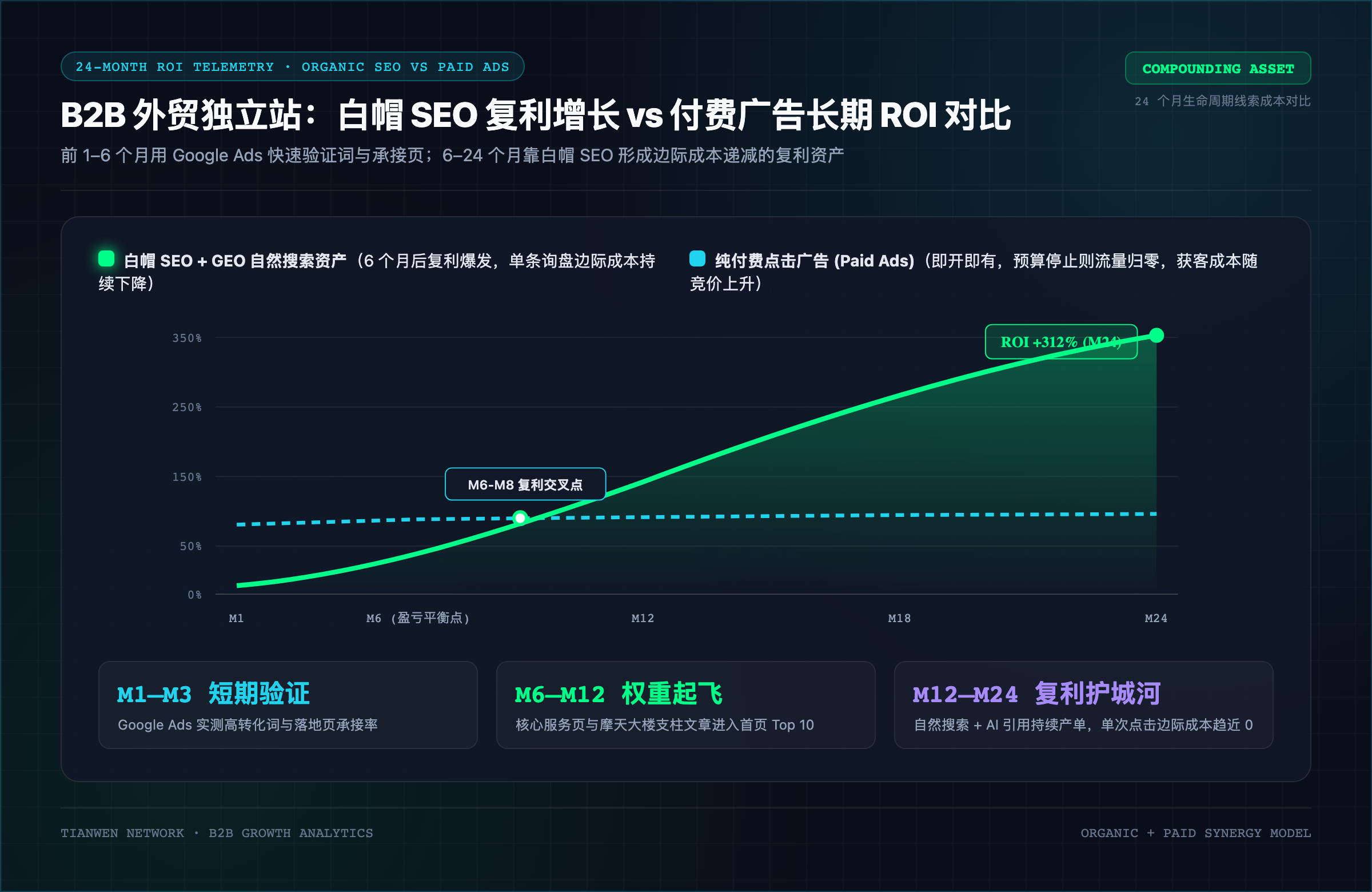

B2B Organic SEO vs. Paid Ads ROI Visualization
Long-Term ROI Comparison: White-Hat SEO Compound Growth vs. Paid Advertising Investment | Tianwen Network B2B Data Dashboard

Why Many Foreign Trade Clients Ultimately Prioritize These Few Things

  • ✓
    Direct communication—no repeated handoffs to outsourcing teams or sales intermediaries.

    For export enterprises, the biggest fear isn’t slowness—it’s having numerous communications yet still failing to clearly convey products and market positioning on the website. We strive to shorten the communication chain so decisions translate faster onto the live pages.

  • ✓
    We won’t lure you into risk with short-term ‘black-hat’ tactics.

    Many clients truly seek long-term, stable inquiry volume—not a brief surge in activity over one or two weeks followed by a sharp drop-off. We prefer steadily building a solid foundation for your website, content, and search pathways.

  • ✓
    You’ll have clearer visibility into where your money goes and why pages are designed as they are.

    Transparency matters greatly to cross-border e-commerce independent site clients. We explain clearly why pages are structured a certain way, why we prioritize specific keywords first, and why we begin by enhancing particular product pages—so you’re never just passively receiving results.

// WHY TIANWEN

We don’t just deliver a website to you
—we also clarify your subsequent growth path.

Many export enterprises dread this: after launching their website, they don’t know how it will grow; after running ads for a while, they’re unsure whether to continue; after months of SEO efforts, they can’t tell if analytics data is moving in the right direction.

What we aim to do goes beyond simply launching your website—we help you systematically align ‘website, content, SEO, SEM, and ongoing review’ into one coherent workflow. That way, every subsequent step you take is grounded in clarity: you’ll know why it’s being done, what comes first, and what can wait.

// OUR WORKFLOW

A four-step collaboration process designed for easy understanding by cross-border e-commerce independent site clients.

01

First, assess whether you currently need a new website more—or better traffic pathways.

We start by reviewing your products, target markets, languages, and current page structure, then determine whether to rebuild the independent site entirely or instead prioritize keyword pathways, service pages, and case study pages.

02

Make the website engaging enough that visitors want to keep exploring.

This phase focuses on improving page messaging, trust elements, product architecture, contact pathways, mobile experience, and loading speed—ensuring visitors don’t bounce immediately upon landing.

03

Then decide how to proceed with SEO—and whether GEO/AI search should be considered concurrently.

Once the website foundation is stable, we move into keyword mapping, content updates, case study enhancements, and page reviews. If your customers are already using AI-powered search to compare suppliers, we’ll assess whether adding GEO-targeted optimization makes sense.

04

Monthly reviews—so you never perform numerous actions without knowing whether they work.

We transfer ownership of foundational tools like Google Search Console and jointly analyze pages, traffic, and lead quality—helping you identify which actions to continue and which to pause.

// FAQ

Three most frequently asked practical questions from cross-border e-commerce independent site clients.

1. How long before meaningful changes appear after launching an independent site and starting SEO?

For a new site, initial priorities include stabilizing page architecture, product messaging, and core data tracking. Consistent, measurable organic search improvements typically require sustained monthly effort. Rather than promising quick wins, we focus on transforming your website step-by-step into a reliable lead-generation asset.

2. Do your websites prioritize aesthetics—or actual customer conversion?

We certainly value visual design—but even more critical is ensuring that visitors quickly grasp what you sell, who it’s for, why they should trust you, and how to contact you next. For cross-border e-commerce independent sites, this functional clarity delivers far greater value than mere visual ‘sophistication’.

3. Will continuing SEO, SEM, or GEO efforts make things increasingly complex?

Yes, complexity will increase—so it’s critical to clarify the foundational roadmap from the start. Our goal is to help you understand which actions to prioritize and which investments can be deferred, rather than letting the project spiral into confusion where even you can’t clearly articulate what problem each step solves.

Latest Tutorials & Tools

Hands-on Google Ecosystem Tutorials & Practical Export Tools—Updated Daily

How to Choose an SEO Agency for a B2B Export Website: Six Questions With Verifiable Answers
2026-09-18
View All Tutorials →